
Showing posts with label adoration of the mystic lamb. Show all posts
Showing posts with label adoration of the mystic lamb. Show all posts
May 3, 2011
The Secret History Of Art Forgery--Part Two
A talk in benefit of Venice in Peril, at the Royal Geographic Society, London in April 2011. Part Two.


The Secret History Of Art Forgery--Part One
A Talk in benefit of Venice in Peril, at the Royal Geographic Society, London in April 2011. Introduction by John Julius Norwich. Part One.
Dec 26, 2010
Noah and The Mystic Lamb on Christmas Edition of NPR's All Things Considered
Listen to Noah on the Christmas edition of NPR's All Things Considered as he discusses his new book, Stealing the Mystic Lamb: The True Story of the World's Most Coveted Masterpiece.

Text reprinted from npr.org:
It's the size of a barn door, weighs more than an elephant, and is one of the most famous and coveted paintings in the world.
It's the Ghent Altarpiece — also called Adoration of the Mystic Lamb, after a central panel showing hordes of pilgrims gathered to pay homage to the Lamb of God.
Other panels depict the Annunciation, Adam and Eve, the Virgin Mary, John the Baptist and a crowned Christ in detail so exacting that you can pick out individual hairs in a beard, or dirt on a pilgrim's foot.
Artist Jan van Eyck completed the Ghent Altarpiece around 1432. Author Noah Charney tells NPR's Guy Raz that it's arguably the single most important painting ever made.
"It's the first great oil painting — it influenced oil painting for centuries to come," Charney says. "It's the first great panel painting of the Renaissance, a forerunner to artistic realism. The monumentality of it and the complexity of it fascinated people from the moment it was painted."
Stealing the Mystic Lamb: The True Story of the World's Most Coveted Masterpiece
By Noah Charney
Hardcover, 336 pages
PublicAffairs
List Price: $27.95
Charney's new book, Stealing the Mystic Lamb: the True Story of the World's Most Coveted Masterpiece, traces the painting through six centuries of war, theft and intrigue.
150 Years Of Peace
The altarpiece was painted for the cathedral of St. Bavo, in Ghent. And during the first century of its existence, nothing much happened.
Then, in 1566, all hell broke loose. Protestant militants broke down the cathedral doors with an improvised battering ram, intending to burn the altarpiece, which they considered to be an example of Catholic idolatry and excess. But alert Catholic guards had disassembled the enormous work and hidden it in the cathedral tower, where it survived unscathed.
Over the next few centuries, the Ghent Altarpiece was taken as booty in the Napoleonic Wars and then returned to Ghent. Parts of it were stolen by a vicar at St. Bavo and ended up, after several sales, in a Berlin museum.
When World War I broke out, a brave cathedral canon hid the painting away in a junkman's wagon for safety. It took the Treaty of Versailles to finally reunite all the panels in their original home.
Enduring Mystery
The Ghent Altarpiece didn't stay safe for long. Thieves broke into the cathedral one night in 1934 and made off with the lower left panel.

"This is the enduring mystery that really is part of the popular cultural awareness of the people of Ghent still to this day," Charney says.
The theft has never been solved. Visitors to St. Bavo Cathedral today will see a copy of the missing panel, painted during World War II. The copy is so good that many people thought it might be the original, hidden in plain sight, though recent conservation work has disproved that theory.
Raiders Of The Mystic Lamb
Missing panel and all, the Ghent Altarpiece was stolen one last time during World War II, on the orders of Nazi Gen. Hermann Goering.
"This may sound very silly," says Charney, "but in fact, the Nazis and Hitler in particular were absolutely convinced that the occult and the supernatural was real," and the Ghent Altarpiece was thought to be a sort of mystical treasure map showing the location of relics of Christ's passion.
The altarpiece ended up hidden with thousands of other looted artworks in a converted salt mine in Austria. The local SS commander had wired the mine with dynamite, determined to destroy all the art as the Allies began closing in.
Charney says the Ghent Altarpiece was eventually saved through the heroism of salt miners who disabled the bombs, and the work of local Austrian resistance fighters and Allied "monuments men" whose job it was to hunt for stolen art.
"There was this race," Charney says, "with the Allies trying to get to the mine before the SS could blow it up, and it was very close to every one of those works being completely destroyed."
But the painting was saved, and you can see it today at the St. Bavo Cathedral in Ghent.
"Each time I see it, I notice something new," Charney says. "For instance, I think it may be the first work of the pre-modern period to show someone laughing."
Excerpt: 'Stealing The Mystic Lamb'

Stealing the Mystic Lamb: The True Story of the World's Most Coveted Masterpiece
By Noah Charney
Hardcover, 336 pages
PublicAffairs
List Price: $27.95
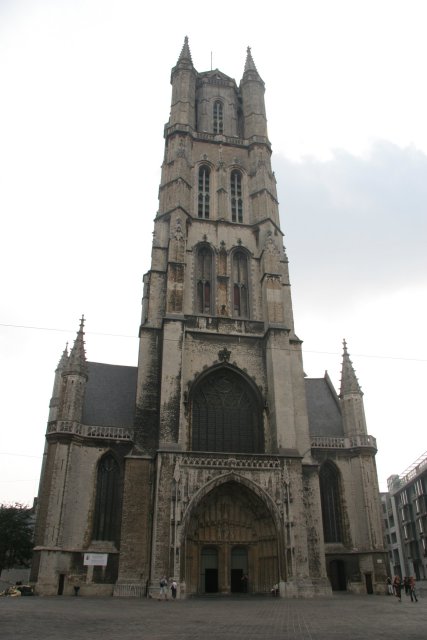
As the oak door to the chapel swings open, one is first struck by the scents: the cool, ancient stone of the walls of Saint Bavo Cathedral, the smell of frankincense, and then the surprising notes of old wood, linseed oil, and varnish. The cathedral in Ghent, Belgium, abounds with stunning religious art, but one artwork stands out among the rest. After six hundred years of nearly constant movement, The Ghent Altarpiece is at last back in the cathedral for which it was painted.
Jan van Eyck's masterpiece has been involved in seven separate thefts, dwarfing the next runner-up, a Rembrandt portrait, lifted from London's Dulwich Picture Gallery on a mere four occasions. From enduring questions surrounding the movement, through theft and smuggling, of the altarpiece as a whole to the mystical symbolism of its content, the altarpiece has haunted scholars and detectives, hunters and protectors, interpreters and worshippers.
It is one of art history's great unsolved mysteries.
Those who stand before the altarpiece cannot but feel overwhelmed by its monumentality. The Ghent Altarpiece comprises twenty individual painted panels linked in a massive hinged framework. It is opened on its hinges for religious holidays but remains closed for most of the year, at which point only eight of the twenty panels, which were painted on both recto and verso (front and back sides), are visible. The subject matter of the verso panels, visible when the altarpiece is closed, is the Annunciation: The angel Gabriel tells Mary that she will bear the Son of God. Portraits of the donors who paid for the altarpiece, and their patron saints, also grace the back.
The altarpiece has a puzzle-box appearance, and inside its treasures lie patiently in wait for decipherers. When open, the altarpiece's center displays an idealized field full of figures: saints, martyrs, clergy, hermits, righteous judges, knights of Christ, and an angelic choir, all making a slow pilgrimage to pay homage to the central figure — a Lamb on a sacrificial altar, standing proudly, while it bleeds into a golden chalice. This scene is referred to as "The Adoration of the Mystic Lamb." The precise iconographic meaning of the Adoration of the Mystic Lamb panel and the meaning of the dozens of obscure symbols within it have been the subject of centuries of scholarly debate.
Above the vast field of the Adoration of the Mystic Lamb, in the upper panels, God the Father sits enthroned, with Mary and John the Baptist on either side. The figure has a hand raised in blessing, a hand painted with an astonishing realism: veins bulge and tiny hairs curl out of the pore-scored skin. At his foot, a crown is clustered in light-reflecting jewels; the fringe of his cloak is woven in gold threads, and above his head arch rune-like inscriptions. Individual hairs were lovingly painted into his beard, and his almond eyes express a power and a weariness that are altogether human.
The level of minute detail in so enormous an artwork is unprecedented. Until the altarpiece was painted, only portrait miniatures and illuminated manuscripts contained such detail. Nothing like this intricacy had ever been seen before on such a grand scale, by artists or admirers. The great art historian Erwin Panofsky famously wrote that van Eyck's eye functioned "as a microscope and a telescope at the same time." Viewers of The Ghent Altarpiece, Panofsky explained, are privy to God's vision of the world, capturing "some of the experience of Him who looks down from heaven, but can number the hairs on our head."
In The Ghent Altarpiece jewels shine with refracted light. One can see individual hairs on the manes of horses. Each of the altarpiece's hundred-plus figures have been given personalized facial features. Each figure's face is unique and retains the detail of a portrait — sweat, wrinkles, veins, and flared nostrils. Details range from the mundane to the elegant. Viewers can make out tufts of grass, the wrinkles in an old worm-eaten apple, and warts on double chins. But they can also see the reflection of light caught in a perfectly painted ruby, the folds of a gilded garment, and individual silvery hairs amid the chestnut curls of a beard.
The secret weapon that permitted such detail was oil paint. Because oil paints are translucent, artists can build up layer upon layer, without covering up what lies beneath. The preferred medium before van Eyck's time, egg-based tempera, was essentially opaque. One layer blotted out the previous one. Oil allowed for a great deal more subtlety and was also easier to control. Van Eyck used some brushes that were so small as to contain only a few animal hairs for bristles, permitting an entirely new level of intricacy. The result is a visual feast, a galaxy of painterly special effects that at once dazzle and provide days of viewing interest, prompting viewers to examine the painting from afar and up close, to decipher as well as to bask in its beauty.
The Ghent Altarpiece, the young van Eyck's first major public work, was also the first large-scale oil painting to gain international renown. Though he did not invent oil painting, van Eyck was the first artist to exploit its true capabilities. The artistry, realistic detail, and use of this new medium made the artwork a point of pilgrimage for artists and intellectuals from the moment the paint dried and for centuries to come. The international reputation of the painting and its painter, particularly taking into account its establishment of a new artistic medium that would become the universal choice for centuries, makes for a strong argument that The Ghent Altarpiece is the most important painting in history.
It is a work of art that centuries of collectors, dukes, generals, kings, and entire armies desired to such an extent that they killed, stole, and altered the strategic course of war to possess it.
From Stealing the Mystic Lamb by Noah Charney. Reprinted by arrangement with PublicAffairs, a member of the Perseus Books Group.
Nov 30, 2010
The Ghent Altarpiece: Secret History Of Art Podcast

Nov 28, 2010
Van Eyck "The Ghent Altarpiece"
 Jan van Eyck
 The Ghent Altarpiece
(1432)This monumental altarpiece, one of the most important works in the history of art, also has the dubious distinction of being the most frequently stolen artwork of all time. It is therefore the most desired and victimized painting in history.
Since its completion in 1432, this twelve-panel oil painting has disappeared, been looted in three different wars, burned, dismembered, copied, forged, smuggled, illegally sold, painted over, censored, attacked by iconoclasts, hidden away, hunted by Nazis and Napoleon, prized by The Louvre and a Prussian king, damaged by conservators, returned as war reparations, stored in castle vaults and secret salt mines, used as a diplomatic tool, nearly been blown up, ransomed, rescued by Austrian double-agents, and stolen a total of thirteen times.
 Perhaps the single most influential painting in the history of art, it is certainly the most important object in the history of art theft. No other artwork has been subject to so many adventures and crimes, both attempted and successful. Though an inanimate object, the enormous altarpiece in all its intricacies and intrigues develops a personality of its own. Indeed, this disappearing masterpiece seems loathe to stand still for too long.
There is even a mystery around its creation. Everyone has heard of Jan van Eyck (1395-1441), but what about Hubert van Eyck? An inscription was discovered in the 19th century which reads that this artwork was begun by Hubert van Eyck and finished by Jan, the painter’s brother. But while evidence exists that a painter called Hubert van Eyck lived in Ghent at the time that the Ghent Altarpiece was painted, not a single authenticated painting by Hubert exists today. Some think that the inscription was a contemporary forgery, while others think that Hubert van Eyck is a lost genius. Art historians are still divided.
What makes this painting so important to the history of art? What, beyond its beauty, made it so desired as to have been the victim of so many crimes?
It is the first major work by the young genius, Jan van Eyck. While Jan did not invent oil painting, as has been popularly misconceived, he was the first to take full advantage of the capabilities of the new medium, which permitted infinitely greater detail than the previous painting method, tempera, which used opaque egg yolk to bind pigment, rather than translucent oil. After this painting, oil would become the universal preferred medium. Jan’s advances in oil were for painters what the first use of steel was for architects.
Art historians love to recite “firsts.” So while Jan was not the first oil painter, he was the first to paint:
· monumental works with an intricate level of detail usually reserved for portrait miniatures and illuminated manuscripts.
· observed naturalistic details, such as the effect of water seen through glass, the light reflecting in a horse’s eye, and botanically-identifiable plants.
· the un-idealized human nude, in the figures of Adam and Eve.
· individually detailed faces in a massive crowd scene with over one-hundred figures, taking the time to render vivid portrait-like expressions, if not actual portraits.
· articulated bodies beneath painted clothing, the people wearing the clothes rather than the clothes floating around the people.
· using disguised symbolism, imbuing realistically-realized and situated objects with a covert Christian symbolism.
The following other statements will clarify what may be said historically about Jan and Hubert:
· Hubert van Eyck was indeed a painter and brother to Jan. He was commissioned to paint the Ghent Altarpiece, but he died so soon after having received the commission that his presence is all but inarticulate. The painting as we see it is therefore wholly the work of Jan.
· Jan did not invent oil painting, but did bring it to an unprecedented level of excellence, turning the mere binding of pigments with oil into a masterful medium that would be preferred by every painter from his day forth.
· Along with Giotto in Italy, Jan may be considered the first Renaissance artist.
· In his unprecedented realism, Jan may be considered a forefather of Realism as an artistic movement.
· The Ghent Altarpiece being Jan’s premiere major artwork may be seen as the first instance of his many “firsts” as an artist.
· Because it is the most frequently stolen painting in history, it follows that the Ghent Altarpiece is also the most desired painting in history.
For historians of art and art crime, the Ghent Altarpiece should be number one on the list of what must be seen.
Below is a chronology of events in the history of The Ghent Altarpiece. For more images and details, visit www.mysticlamb.com. For the full story of the most frequently stolen, and arguably the most important painting ever made, please see the new book, Stealing the Mystic Lamb: The True Story of the World’s Most Coveted Masterpiece (PublicAffairs).
Chronology of Key Events Related to The Ghent Altarpiece
c. 1385
Hubert van Eyck is born, probably in Maaseyck.
c. 1395
Jan van Eyck is born, probably in Maaseyck.
1419
Philip the Good, the third Duke of Burgundy, rules Flanders.

1425
Jan moves to Bruges and is appointed Court Painter and valet de chamber to Philip the Good.
1426
Hubert van Eyck dies.
The Ghent Altarpiece, originally commissioned of Hubert van Eyck by Joos Vijd (perhaps as early as 1420) is taken up by Jan. The state of the altarpiece at this time is unknown.
The Burgundian treasury in Lille pays for the first of many journeys and “secret” missions to “distant lands” undertaken by Jan in the service of Philip the Good.
6 May 1432
The Ghent Altarpiece is presented to the public for the first time, at the occasion of the baptism of Philip the Good’s son, Joos.
1433
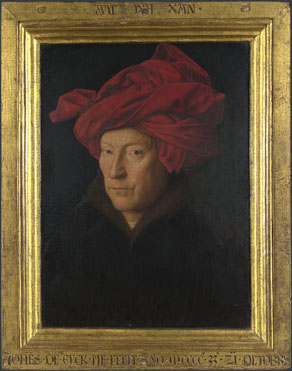
Jan paints Portrait in a Red Turban, unanimously considered to be a self-portrait.
1434
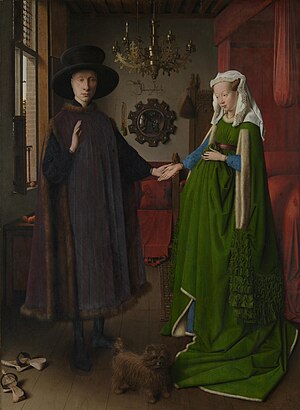
Jan paints his second-most famous work, The Arnolfini Wedding Portrait (also known as The Marriage Contract).
9 July 1441
Jan dies and is buried in Bruges.
1550
Giorgio Vasari credits Jan with the “invention of oil painting,” adding to his already considerable renown and mystique.
19-20 August 1566
Calvinist rioters break into Saint Bavo Cathedral, intent on burning The Ghent Altarpiece as a Catholic icon. They are foiled by the wiles of a small band of knights who dismantled the altarpiece and hid it in one of the church towers, locking themselves into the stairwell, and prepared to defend it with their lives.
1781
Emperor Joseph II of Bohemia and Hungary visits the cathedral to see the famous altarpiece. While he admires the painting, he finds the images of the nude, warts-and-all Adam and Eve too realistic and ignoble for his Enlightenment tastes. The Adam and Eve panels are removed to the cathedral archives.
1794
French Republican troops capture the city of Ghent and steal the four central panels of the altarpiece, sending them to The Louvre.
1815
The four central panels are returned to Ghent after the Battle of Waterloo, a thank-you gift from the new French king, Louis XVIII, who had been sheltered in Ghent when Napoleon escaped from Elba.
1816
Vicar Le Surre steals the wing panels of the altarpiece from the cathedral while the bishop is out of town. They are smuggled and sold to Brussels art dealer L J Nieuwenhuys, who almost certainly commissioned the theft. They will be bought by British collector Edward Solly, and sold once more to Frederick William III, the King of Prussia, who hoped to build a collection that would out-do The Louvre.
1822
A fire breaks out in Saint Bavo Cathedral, and the remaining panels of the altarpiece suffer minor damage.
1823
The wing panels of the altarpiece are cleaned at the Kaiser Friedrich Museum in Berlin, which had inherited the Prussian royal collection. On the back of one of the panels the famous and mysterious inscription is discovered, suggesting for the first time to art historians that the previously unknown artist “Hubert van Eyck” began The Ghent Altarpiece.
1914-1918
At the start of the First World War The Ghent Altarpiece is divided among three cities. The Adam and Eve panels are in Brussels, at the Musée des Beaux-Arts. The stolen wing panels are in Berlin. And the four central panels remain in Ghent, on display at the cathedral.
When German occupation of Ghent seemed inevitable, Canon Gabriel van den Gheyn arranged to smuggle the central panels out of the cathedral and hide them for the duration of the war, to preserve them from German art hunters. Germans attempt to discover the location of the central panels in order to steal them on five separate occasions during the occupation.
The Treaty of Versailles specifically cites The Ghent Altarpiece and insists that the wing panels be returned from Berlin to Ghent.
1923
Only now is the Treaty of Versailles enforced, and the wing panels returned to Ghent. The Adam and Eve panels are likewise returned from Brussels, so the altarpiece is whole once more.
10 April 1934
The Righteous Judges and Saint John the Baptist panels are stolen from the cathedral during the night. A ransom demand follows. The Saint John panel is returned in a show of good faith on the part of the criminals, but the ransom is never paid. A total of 13 ransom notes follow.
25 November 1934
Arséne Goedertier collapses of a heart attack and whispers with his dying breath that he is last man on earth to know the location of the stolen Righteous Judges panel. Four magistrates begin a one-month investigation before informing the police. The situation suggests a cover-up.

1937
Righteous Judges theft case officially closed. Amateur detectives will pick up the case and find fascinating clues that evaded, or were intentionally over-looked by, the official investigators.
1938
Belgian Minister of the Interior Octave Dierckx is approached by a lawyer who, on behalf of an anonymous client, offers to return the Judges panel for 500,000 francs. The matter was brought before the Belgian prime minister, Paul-Henri Spaak, who rejected the negotiations out of hand, saying, “One doesn’t do business with gangsters. We’re not in America
1939
Conservator Jef van derk Veken begins his replacement copy of the Righteous Judges panel. He completes it in 1945, and the following year it is installed with the 11 remaining original panels of The Ghent Altarpiece.

May 1940
At the start of the Second World War, The Ghent Altarpiece is sent for safe-keeping to Chateau de Pau in the south of France.
Summer 1942
On order from Hermann Göring, the altarpiece is stolen from Chateau de Pau by Dr Ernst Buchner, director of the Bavarian state museums. It is brought first to Paris, then to Castle Neuschwanstein, were it is treated by a conservator.
1943
Monuments, Fine Arts, and Archives branch of the Allied Army is founded. The “Monuments Men” would seek out and protect tens of thousands of stolen and damaged artworks and monuments in the wake of fighting across Europe. Among the most prominent of the Monuments Men rank Robert K. Posey and Lincoln Kirstein. Attached to the Allied Third Army, they would lead the Allied effort to save the thousands of stolen artworks stored in a hidden warehouse in the Austrian salt mine of Alt Aussee.
8 April 1945
Operation Ebensburg begins, led by Austrian double-agent Albrecht Gaiswinkler. The efforts of his commando team, Alt Aussee miners, and the local Austrian Resistance would delay the intended destruction of the mine and all its contents until the Allied Army arrived.
8 May 1945
The Allied Third Army arrives at Alt Aussee and secures the salt mine. Posey and Kirstein help to excavate over twelve-thousand stolen masterpieces stored there.
21 August 1945
Posey accompanies The Ghent Altarpiece on its storm-tossed flight back to Belgium. He will receive the highest honor awarded by the Belgian government for his service in preservation of their national treasure.
1946
Jef van der Veken’s copy of the Righteous Judges panel is installed along with the recovered original, so that The Ghent Altarpiece appears once more complete.
1974
Conservator Jos Trotteyn, after two decades of cleaning The Ghent Altarpiece, suddenly believes that the Righteous Judges panel, painted by Jef van der Veken during the Second World War, has been replaced by the 600-year-old original. Tests are run by the diocese, who announce that, unfortunately, the panel on display is the van der Veken copy, not the stolen original. But the test results are never made public. Many believe that the stolen original is back in its place, and the altarpiece is whole once more.
2010
The Getty Foundation and the Belgian Government announce a plan to restore The Ghent Altarpiece for the first time in decades. The restoration could finally resolve the mystery of the Righteous Judges panel. The debate over its restoration was recently profiled in The New Yorker, in an article by Peter Schjeldahl.
The Ghent Altarpiece, for all its twists and turns, remains the most frequently stolen, and victimized, artwork in history, the subject of 13 crimes including seven separate thefts. It is also, one may argue, the single most influential, and most desired, painting in history.
Subscribe to:
Posts (Atom)